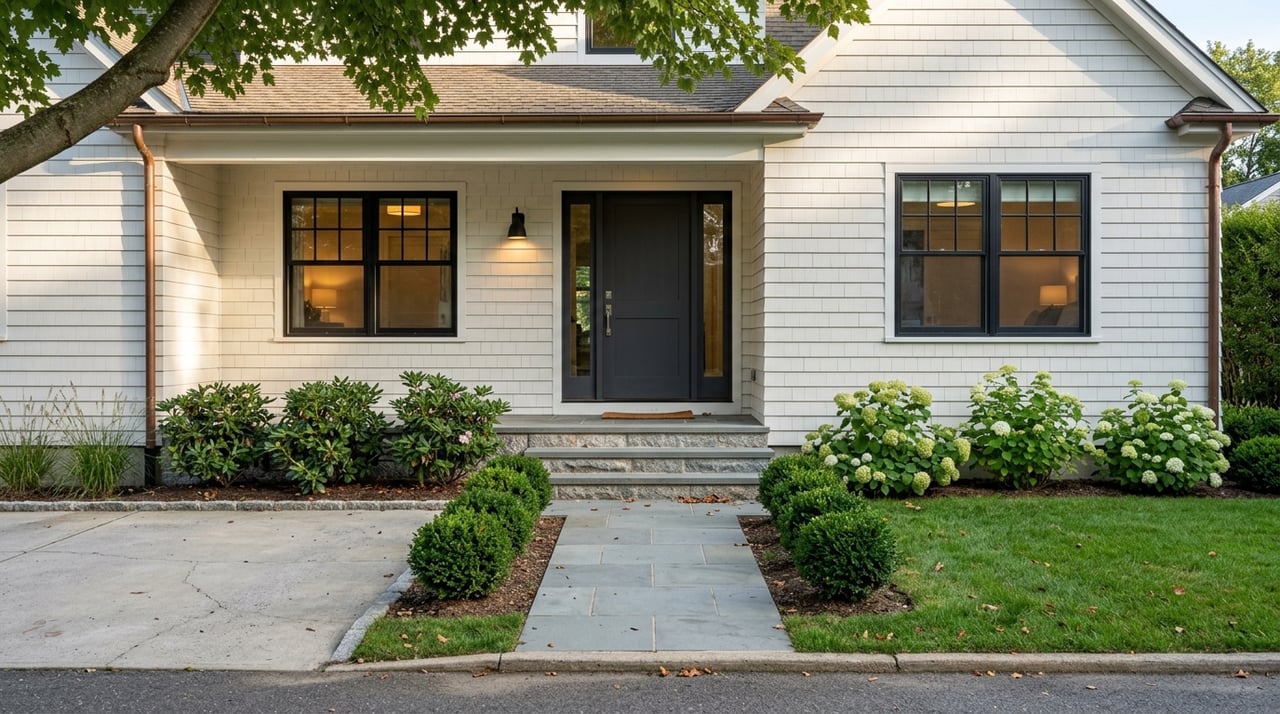
Trading A City Condo For A Newton Home: How To Plan The Move
Michelle Easter May 7, 2026
Michelle Easter May 7, 2026
Thinking about trading your Boston condo for a Newton home? It can be an exciting move, but it also comes with a bigger price tag, a different daily rhythm, and more moving parts than many buyers expect. If you plan ahead, you can make the transition with more clarity around budget, timing, commute, and school logistics. Let’s dive in.
The biggest surprise for many condo owners is that the move-up cost is not just the purchase price. In Newton, the jump often includes a larger mortgage, higher property taxes, different insurance costs, ongoing maintenance, and the expense of furnishing or updating a larger home.
Newton’s FY2026 residential tax rate is $9.69 per $1,000 of assessed value. Based on the city’s figures, a $1.5 million assessment implies about $14,535 per year in property taxes, while a $1.75 million assessment implies about $16,957.50 per year, before any exemptions.
The city’s FY2026 classification materials also show how much of a step-up market Newton can be. In 2024, the median sale price was $1.75 million for single-family homes and $1.121 million for condos, and 61.52% of single-family sales exceeded $1.5 million.
If you currently own a Boston condo, your equity may give you a strong starting point, but it may not cover the full jump in carrying costs. That is why your first planning conversation should focus on monthly ownership costs, not just what you can bid.
Newton is an active market, but it is still firmly a high-priced one. The city reported 551 single-family sales and 345 condo sales in 2024, which points to meaningful transaction volume while reinforcing that buyers are entering a competitive move-up environment.
That matters because timing decisions become more important when you are selling one property and buying another. You want a strategy that protects your leverage, preserves flexibility, and keeps your housing timeline realistic.
Before you tour homes, estimate your likely condo sale proceeds as carefully as possible. That means looking at your expected sale price, mortgage payoff, taxes and closing costs, and how much cash you want to keep in reserve after closing.
For many buyers, the most useful number is not maximum approval. It is the amount you can put down while still holding enough liquidity for moving costs, repairs, furniture, and a cushion for the first year in a larger home.
A Newton purchase often works best when you set aside reserve funds for:
Newton is not organized around one downtown. The city describes Newton as a place with 13 distinct villages, and it specifically notes that there is no single downtown or Main Street.
That village structure matters when you are moving from a condo lifestyle in Boston. In the city, you may be used to compact routines and quick access to restaurants, transit, and errands. In Newton, your daily experience often depends on which village you choose and how it fits your routine.
Newton’s 13 villages are:
The city also categorizes parts of Newton by center type. Village centers such as Newton Centre, Newtonville, Nonantum, and West Newton have a broader mix of shopping, dining, and parking. Neighborhood and convenience centers tend to be more local in feel, while Route 9 Chestnut Hill and Needham Street function as retail and service clusters.
This is why a Newton search should begin with lifestyle mapping. If you want a more village-style routine with easier access to shops and services, you may focus on one set of locations. If you prefer a more residential setting, your shortlist may look different.
When you move from a Boston condo to a Newton home, your routine usually changes in practical ways. Newton reports that 19.6% of the city is open space, which helps explain why the move often means more room, more separation between destinations, and more coordination in daily life.
A useful way to narrow your search is to build it around your real week, not your ideal week. Think about where you work, how often you commute, when you run errands, and what your mornings and evenings need to look like.
Ask yourself:
If school assignment matters for your move, treat it as part of the same decision as commute and location. Newton Public Schools serves 11,494 students across 15 elementary schools, 4 middle schools, 2 comprehensive high schools, and 2 alternative high school programs.
The district directs families to the City of Newton’s Find Your School tool, and it notes that some addresses fall into buffer zones, where two schools may be listed. That means you should verify address assignment early, before you get too far into evaluating a specific property.
This step matters even more if you are moving within Newton or want a student to remain at a prior school after a move. The district notes that families may need to update their address or file a Continuation in Placement form in that situation.
School hours can also affect the shape of your day. Newton Public Schools currently lists 8:10 a.m. as the elementary start time and 9:00 a.m. as the high school start time, with weekly early-release patterns and special early-release dates during the year.
In other words, a home that looks perfect on paper may feel less convenient once you layer in drop-offs, pickups, after-school care, and a Boston commute. It is smarter to test the address against your actual schedule before you fall in love with the house.
If you still need regular access to Boston, transit can play a major role in your search. The city lists Green Line D stops in Newton at:
Newton also has Worcester/Framingham commuter rail stops at:
MBTA materials also show accessibility-improvement projects in progress at Auburndale, West Newton, and Newtonville. For some buyers, proximity to one of these stations helps maintain a workable city connection while gaining the extra space that Newton offers.
The key is to compare transit, school assignment, and errands at the same time. A strong location match is rarely about one factor alone.
One of the most important questions is whether to sell your condo first or buy first. There is no universal answer, but there should be a clear plan.
A safer approach is usually to work through the move in sequence. Start with pre-approval, estimate your net condo proceeds, decide whether you can tolerate a short overlap in ownership, and build a fallback plan in case the Newton search takes longer than expected.
Purchase offers and sales contracts can include contingencies such as financing and inspection. For some buyers, that flexibility is useful, but in a high-priced move-up market, your overall timing still needs to be realistic and well coordinated.
Some buyers try to line up both closings at once. That can work, but it can also create unnecessary pressure.
A short overlap may give you more room to move carefully, complete small improvements, or avoid rushing into the wrong purchase. The tradeoff is that you need the financial ability to carry that overlap responsibly.
Bridge or swing loans are one possible option in some cases. Lenders generally require documentation showing that you can carry your current home, your new home, the bridge financing, and your other obligations.
For many households, the cleaner path may be one of these:
The right choice depends on your liquidity, risk tolerance, and how specific your Newton home criteria are.
Even if you are buying a well-kept home, it is wise to avoid using every available dollar at closing. A larger house often brings immediate spending that condo owners do not always anticipate.
You may want funds available for maintenance items, minor cosmetic changes, or functionality updates after move-in. The goal is not to predict every expense. It is to avoid turning your first months in Newton into a cash crunch.
This is especially important if you are buying based on location, lot, or long-term fit rather than turnkey finishes. In Newton, that can be a very reasonable strategy, but only if your post-closing reserves stay intact.
The smoothest condo-to-house transitions usually start before the first offer, not after it. When your financial plan, location priorities, and timing strategy are aligned, you can make decisions faster and with more confidence.
A practical move plan should cover:
That kind of planning can help you avoid two common mistakes: stretching too far on price and choosing a house that does not support your daily life.
Moving from a Boston condo to a Newton home is more than a trade-up in square footage. It is a shift in how you live, move, and organize your week. With a thoughtful strategy, you can make that transition in a way that protects both your finances and your peace of mind. If you are planning a Boston-to-Newton move and want a discreet, senior-led approach to timing, valuation, and search strategy, Easter Entwistle Advisors can help you plan the next step.
We don't just close deals; we build portfolios and long-term wealth. Whether you are an international buyer or a local seller, we provide a concierge experience that manages every detail. Reach out to us to experience the power of having a dedicated advisory team in your corner.

EASTER ENTWISTLE ADVISORS | CORCORAN PROPERTY ADVISORS
14 NEWBURY ST BOSTON, MA 02116