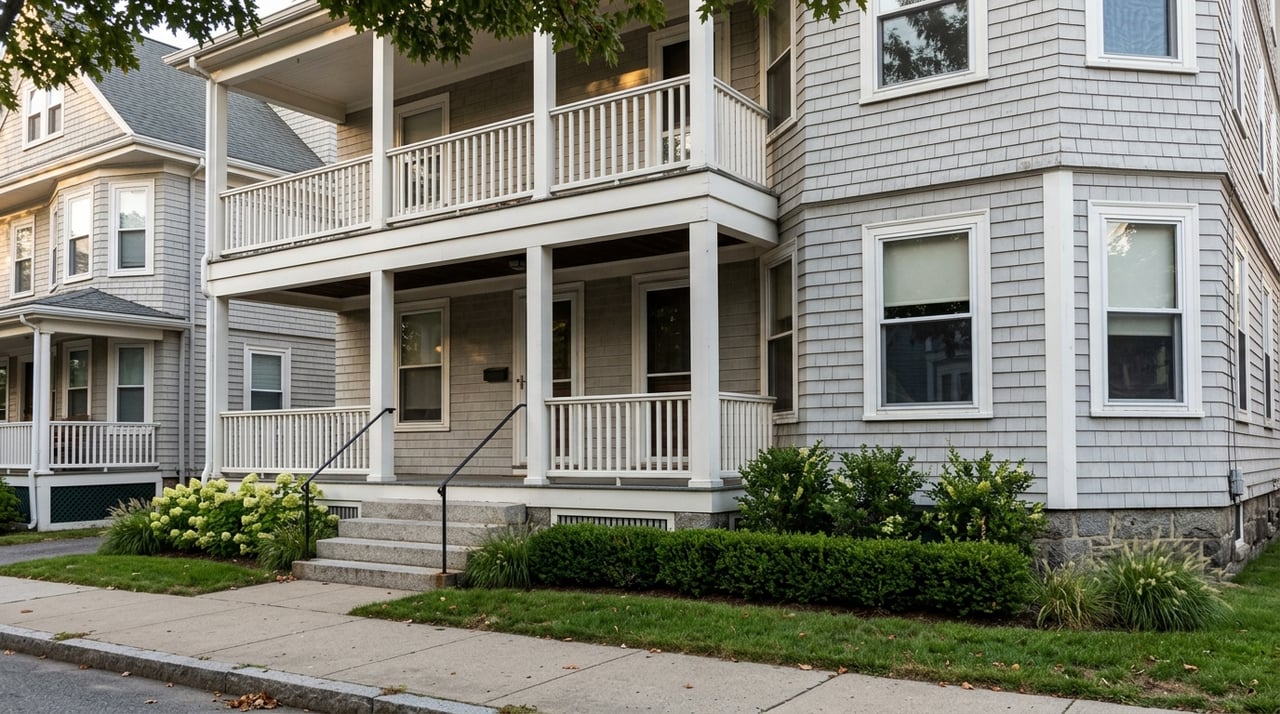
Why Quincy Offers Better Value for Boston-Area Buyers
May 28, 2026
May 28, 2026
If Boston prices have you rethinking your search, Quincy deserves a serious look. Many buyers want to stay connected to Boston’s jobs, transit, and daily rhythm without taking on Boston-level pricing, but they also do not want to compromise too much on convenience or lifestyle. The good news is that Quincy can offer a meaningful value gap, not just a slight discount, while still feeling closely tied to the city. Let’s dive in.
Quincy is not a far-flung suburb. It is a dense inner-ring city with 103,430 residents in just 16.6 square miles, which makes it feel much more like an extension of Greater Boston than a fully separate market. If you want urban access with a somewhat wider price range, that distinction matters.
For many buyers, the biggest question is simple: is Quincy actually cheaper than Boston? Based on Redfin’s March 2026 data, the answer is yes in a meaningful way. Quincy’s median sale price was $610,000 compared with $860,000 in Boston, and its price per square foot was $499 versus $764.
That works out to about 29% lower on median sale price and roughly 35% lower on price per square foot. In other words, Quincy is not a bargain-basement market, but it can offer real breathing room if you are trying to balance budget, location, and long-term ownership goals.
Value does not always mean cheap. In Quincy, it more often means better relative pricing for the kind of access many Boston-area buyers still want. You may be able to stay in the same regional job market, keep transit options in play, and open up more housing choices than you would have in many Boston neighborhoods.
That can be especially relevant if you are moving from a Boston rental, a smaller condo, or an entry-level ownership search that feels too constrained. Quincy may create room for different priorities such as more square footage, a different building type, or access to shoreline amenities without pushing your search far outside the metro area.
A lower price point does not mean a slow market. Redfin describes Quincy as very competitive, with homes receiving about three offers on average and selling in around 20 days. Boston, by comparison, averaged about two offers and around 33 days on market in the same period.
That means Quincy can attract buyers who see the same value story you do. If you are considering a move there, it helps to be clear on your budget, your must-haves, and your timing before the right property comes up.
One reason Quincy appeals to a wide range of buyers is that it is not a one-product market. The city assessor’s reporting tracks separate sales for single-family homes, condos, two-family homes, and three-family homes, which signals a more varied housing landscape than many buyers assume.
Quincy is still multi-unit heavy, but less so than Boston. Census Reporter’s ACS 2024 profile shows that 62% of Quincy housing units are in multi-unit structures, compared with 81% in Boston. That means condos and apartments play a major role in both markets, but Quincy is somewhat less dominated by large multi-unit stock.
The city also skews more ownership-oriented than Boston. According to the Census Bureau’s 2020 to 2024 QuickFacts, Quincy’s owner-occupied housing unit rate is 45.2%, while Boston’s is 35.7%. The median value of owner-occupied housing units is also lower in Quincy at $618,500 versus $731,700 in Boston.
Quincy can make sense if you are looking for a next-step ownership move rather than a dramatic lifestyle reset. It may fit buyers who want to remain close to Boston while pursuing one of the following goals:
This is especially relevant if your search has started to feel too narrow in Boston. A broader search area can sometimes improve not only affordability, but also the quality of your options.
For many Boston-area buyers, Quincy only works if the commute still works. The city has four Red Line stations: North Quincy, Quincy Adams, Quincy Center, and Wollaston. Quincy Center also has Commuter Rail service, giving buyers another layer of regional access.
That combination is one of Quincy’s strongest advantages. If you want to stay connected to downtown Boston while widening your price range, multiple transit points can make that easier.
There is also a clear official example of Quincy’s Boston-facing transit connection. The National Park Service directs visitors traveling from Boston to Adams National Historical Park to take the Red Line to Quincy Center, which reinforces how naturally Quincy fits into a Boston-centered transit pattern.
Current MBTA fare information lists subway one-way fare at $2.40, while commuter rail one-way fares range from $2.40 to $13.25 depending on zone. For buyers trying to live car-light, those details matter when comparing total monthly housing and transportation costs.
For many buyers, yes, at least in the right location and with the right routine. If your home search is focused near a Red Line station or Quincy Center, the city can be a practical option for households that want to reduce driving or limit themselves to one car.
Of course, the answer depends on where you work, how often you commute, and what your schedule looks like. But from a market-planning perspective, Quincy is one of the more realistic places to search if you want Boston access without fully depending on a car.
Another part of Quincy’s appeal is that it is not just near the water in a vague sense. Discover Quincy says the city has 52 municipal park locations and 11 municipal beach areas, which adds a real outdoor and shoreline dimension to everyday life.
Wollaston Beach is one of the most recognizable examples. Discover Quincy notes that Quincy Shore Reservation is the formal name for Wollaston Beach, Caddy Park, and Moswetusset Hummock, and that the Department of Conservation and Recreation manages Wollaston Beach.
For some buyers, that matters as much as the pricing gap. If you can combine Boston access, a more flexible purchase price, and a more visible connection to the shoreline, Quincy starts to feel less like a compromise and more like a strategic move.
The most natural Quincy buyer story is often not a move from far away. It is often a move within the same metro area. Redfin’s migration data shows that 78% of Quincy homebuyers searched to stay within the metro area, and Boston’s migration profile is similarly metro-focused.
Redfin notes that this reflects search behavior rather than confirmed move data, so it should be read carefully. Still, it supports a practical pattern many buyers already recognize: Boston apartment or condo first, then Quincy condo, townhouse, or small single-family home as budget, space, and lifestyle priorities evolve.
That sequence can be especially appealing if you want to keep your professional, social, and transit ties to Boston while making a more sustainable ownership decision.
Some buyers also compare Quincy and Boston on property tax rates. Quincy’s FY2026 residential tax rate is $11.78 per $1,000 of assessed value, while Boston’s FY2026 residential rate is $12.40.
That said, Boston also offers a residential exemption for qualified owner-occupants, so a simple side-by-side rate comparison does not tell the whole story. It is better to evaluate taxes in the context of the specific property you are considering rather than assume one city is always cheaper.
If you are considering Quincy, the best approach is not just to ask whether it is cheaper than Boston. The better question is whether it gives you a stronger overall outcome for your budget.
A smart evaluation usually includes:
When you look at Quincy through that lens, its appeal becomes clearer. It is not a discount version of Boston. It is a separate market with its own strengths, and for the right buyer, those strengths can line up very well with both financial and lifestyle goals.
If your Boston search has started to feel too expensive, too tight, or too limiting, Quincy may be one of the most logical places to look next. The pricing gap is meaningful, the transit access is real, the housing stock is more varied than many buyers expect, and the coastal setting adds a distinct quality-of-life advantage.
At the same time, Quincy is still a competitive market, so success usually comes from clear strategy rather than casual browsing. If you want help weighing Quincy against Boston neighborhoods or building a more targeted search plan across Greater Boston, Easter Entwistle Advisors can help you evaluate the market with discretion, clarity, and a senior-led approach.
We don't just close deals; we build portfolios and long-term wealth. Whether you are an international buyer or a local seller, we provide a concierge experience that manages every detail. Reach out to us to experience the power of having a dedicated advisory team in your corner.

EASTER ENTWISTLE ADVISORS | CORCORAN PROPERTY ADVISORS
14 NEWBURY ST BOSTON, MA 02116