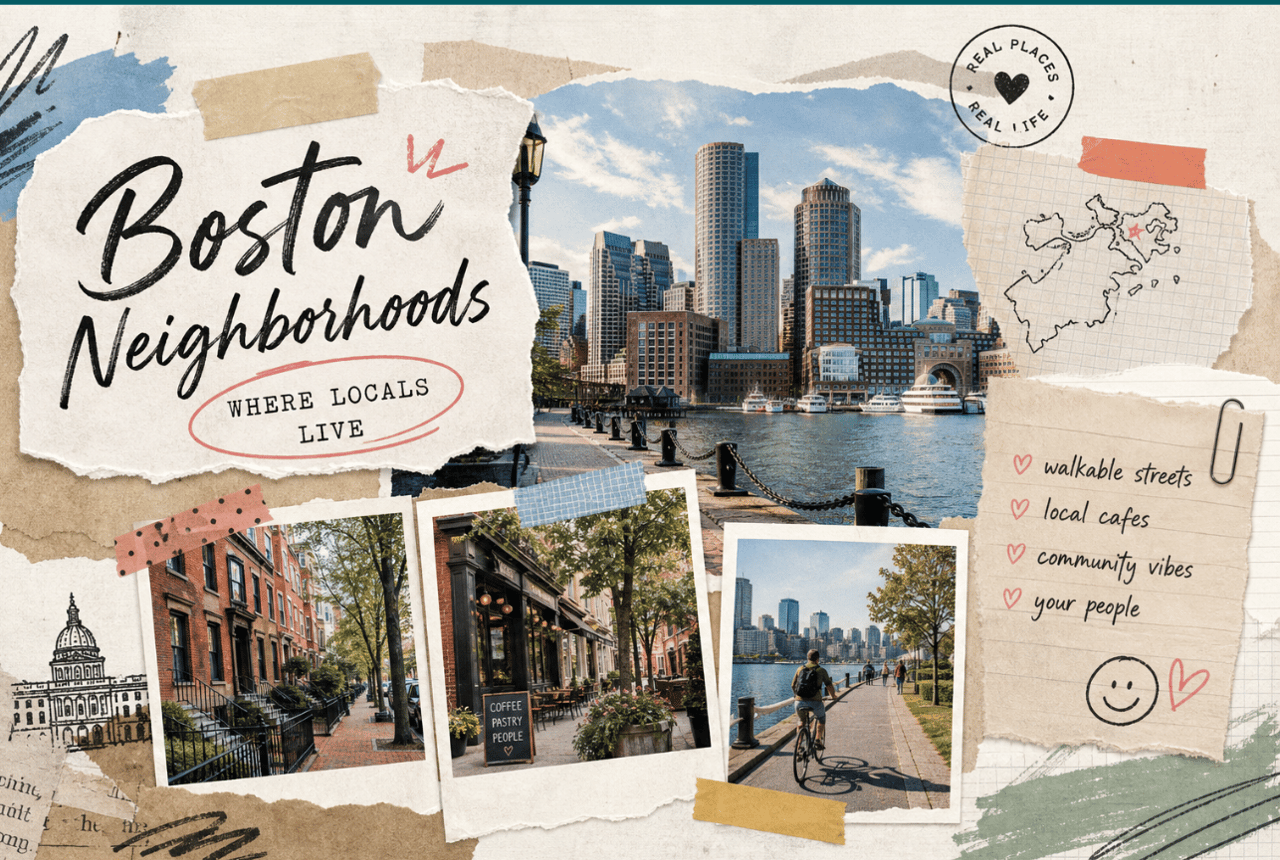
Boston Neighborhood Guide for Finding the Right Area
Michelle Easter May 4, 2026
Michelle Easter May 4, 2026
Boston doesn't operate the way most cities do. Unlike metros where neighborhoods blend gradually into one another, Boston is a collection of distinct, self-contained worlds pressed against each other, each with its own architecture, pace, restaurant culture, and social identity. Pick the wrong one and you don't just face a longer commute: you end up in a fundamentally different life than the one you were imagining. The stark contrasts between neighborhoods, in housing stock, walkability, transit access, and community character, are precisely what make this city so rewarding to navigate with the right boston neighborhood guide.
That distinction matters whether you're relocating from abroad, upgrading from a rental to a first purchase, or trading a suburban address for city living. The team at Easter Entwistle Advisors has extensive local experience navigating every corner of this market, and the pattern they see repeatedly is this: buyers who match their priorities to a neighborhood before they start touring close faster, feel more confident in their decisions, and build more equity over time. This guide reflects that same advisory lens. It profiles Boston's key neighborhoods by lifestyle, price range, walkability, and community feel so you can confidently shortlist two or three areas that actually match how you live.
Boston has 23 official neighborhoods, and this guide to Boston neighborhoods covers the most significant ones across four broad tiers: historic luxury in Back Bay and Beacon Hill, modern waterfront living in the Seaport, lifestyle-led communities like the South End and Jamaica Plain, and value-forward entry points in Allston and Brighton. Use the profiles below to identify which tier fits your priorities, then let the four-question framework near the end of this guide narrow your shortlist to two or three realistic candidates. For a visual reference, the City of Boston's official neighborhood map is a useful companion to the profiles below.
Back Bay is the neighborhood most people picture when they think of Boston. Wide, tree-lined Commonwealth Avenue sets the scene, while Copley Square delivers the cultural anchor: Trinity Church facing the Boston Public Library across the plaza, with Newbury Street's mix of designer boutiques, art galleries, and sidewalk cafes just steps away. It offers a polished, walkable daily life with a strong cultural calendar, and its Transit Score of 87 makes it one of the best-connected neighborhoods in the city. Average rents sit at $4,855 per month, with luxury condo sales clustering around a median of $1,999,000 and a price per square foot near $1,421. The resident profile here commonly includes professionals, empty nesters, and affluent buyers who want neighborhood prestige without sacrificing convenience. For current market context, see aggregated Back Bay home values.
Beacon Hill is Boston's most historically intact neighborhood, and it earns that distinction without effort. Narrow brick sidewalks, gas-lit streets, Louisburg Square, and the gold-domed Massachusetts State House create an atmosphere no new development can replicate. What surprises many buyers is the rental spread: average rents hover around $2,599 per month, making it more accessible than Back Bay on the rental side, while purchase prices remain in luxury territory by most market measures. This is a neighborhood for buyers who value discretion, architectural history, and proximity to Boston Common over a dense restaurant scene. It's also the starting point of the Freedom Trail, which means foot traffic on the main streets but genuine quiet just a block off.
Boston's oldest residential neighborhood built its identity around the Freedom Trail, Old North Church, Paul Revere's House, and a dense street grid of family-run Italian restaurants serving fresh pasta and espresso at outdoor tables. The community feel here is tight-knit and real in a way that newer neighborhoods simply haven't had time to develop. The neighborhood attracts renters and younger professionals who want real neighborhood character, the kind that comes with knowing your butcher and finding a table at a corner trattoria without a reservation. It won't suit buyers who prioritize modern high-rise finishes, but for those who value lived-in texture, it's hard to match.
The Seaport District is Boston's fastest-evolving neighborhood, and its skyline reflects it. Marquee developments like the Echelon Seaport and 22 & 50 Liberty on Fan Pier have repositioned this former industrial zone into a destination for global buyers seeking world-class amenities and harbor views. Average rents sit around $4,442 per month, and the neighborhood draws tech professionals, corporate relocators, and international buyers who want Silver Line access to South Station alongside those harbor views from the living room. For a practical look at Seaport transit options and connections, the Seaport's official guide is a useful resource. For broader rent benchmarks across the city, see current Boston average rents. The honest trade-off is cultural depth: the Seaport's restaurant scene and public spaces are exceptional, but the neighborhood lacks the lived-in history of Beacon Hill or the South End. Buyers who weigh that trade-off consciously tend to thrive here.
Downtown suits one profile better than any other: the executive or corporate relocator who wants maximum transit connectivity and zero commute friction. Faneuil Hall, Quincy Market, the Theater District, and the waterfront are lifestyle anchors beyond the office towers. Average rents near $4,342 per month reflect the premium on central positioning. This isn't a neighborhood for buyers who need weekend quiet or easy access to green space, but for professionals who measure quality of life by how easily they can reach a performance, a business dinner, or an early flight out of Logan, Downtown delivers consistently.
Charlestown is the choice for buyers who have done their research. The Navy Yard, Bunker Hill Monument, a growing restaurant scene along Main Street, and a genuine community identity give it the historic character of Back Bay at a noticeably more accessible price point. The MBTA ferry service and local bus routes connect residents to downtown quickly, keeping the commute manageable for those who work in the Financial District or the Seaport. Average rents in Charlestown run below the Seaport and Back Bay, making it one of the better value propositions among Boston's waterfront-adjacent neighborhoods. The neighborhood draws buyers who want real Boston texture, not just a Boston address, and who are willing to trade the immediate walkability of Newbury Street for a quieter, more residential experience just minutes from the city center.
The South End is Boston's most architecturally cohesive neighborhood outside of Beacon Hill. Victorian brownstones line every block, and the restaurant scene, anchored by standouts like Ostra, Sorellina, Toro, and B&G Oysters, competes with any neighborhood in the city. The SoWa Open Market brings seasonal art, vintage vendors, and food stalls to the southern corridor. Design-conscious buyers, young professionals, and LGBTQ+ households have established this as one of Boston's most sought-after residential markets, and the investment case here aligns well with the lifestyle appeal. For readers exploring dining options and reservations, see a curated guide to fine-dining in the South End. Buyers who enter the South End typically stay.
Fenway carries two identities simultaneously. On one side: Fenway Park, the Museum of Fine Arts, the Isabella Stewart Gardner Museum, and Symphony Hall, a cultural density that few neighborhoods anywhere in the United States can claim. On the other: a large student and young professional population that generates strong rental demand alongside a more transient community feel. The Green Line provides direct access to downtown and beyond. Buyers in Fenway are typically investors who understand the rental dynamics, or young professionals who want the walkability and cultural access and plan to trade up in three to five years.
Jamaica Plain is the neighborhood that consistently surprises buyers who discover it late. Jamaica Pond offers a 1.5-mile path for running, walking, and cycling around one of the city's most accessible natural landmarks. The Arnold Arboretum, Olmsted's masterwork and a National Historic Landmark, ranks among the finest urban green spaces on the East Coast. Centre Street runs through the neighborhood with independent shops, diverse restaurants, and the kind of small-business culture that takes decades to develop. Price points here are more accessible than Back Bay or the South End, and the family-friendly qualities, including strong community schools and park access, make it a serious option for buyers who value outdoor access and authentic neighborhood character over proximity to luxury amenities. For an external comparison of family-focused neighborhoods in Boston, consult a round-up of the best neighborhoods for families in Boston.
Cambridge functions as a market unto itself. The gravitational pull of Harvard and MIT draws academics, biotech professionals, and a deeply international buyer and renter pool that keeps demand consistently high. Prices in many Cambridge sub-markets rival or exceed Back Bay on a per-square-foot basis. Red Line access connects the neighborhood directly to downtown Boston in under fifteen minutes. For international buyers, particularly those seeking proximity to university programs or established immigrant communities, Cambridge is frequently the first conversation, and the Easter Entwistle Advisors team handles a meaningful share of those introductions through their dedicated multilingual advisory division.
Brookline sits just outside Boston but functions as part of the city in day-to-day life. Tree-lined streets, a strong public school system, and a more residential pace make it one of the most consistent choices for families and medical professionals, particularly those working in the Longwood Medical Area. At the same time, areas like Coolidge Corner and Washington Square provide walkable access to restaurants, cafés, and local shops, giving it a balance that’s hard to find elsewhere. The Green Line connects directly into Boston, making commuting straightforward while still offering a quieter home environment. For buyers looking for a slightly more settled, European-feeling lifestyle without giving up proximity, Brookline is often where the search lands.
South Boston has transformed from a close-knit working-class enclave into one of Boston's most competitive residential markets, and it hasn't lost its neighborhood identity in the process. Average rents around $4,253 per month reflect the demand. Waterfront parks, a strong local community culture, and Red Line access via Broadway Station give the neighborhood a rare combination: genuine Boston character alongside modern amenities. Buyers who move quickly on adjacent sub-neighborhoods within South Boston still find value that the core market no longer offers, a window that research, not consensus, opens.
East Boston has shifted quickly over the past decade, moving from a primarily local, tight-knit community into one of the city’s more closely watched neighborhoods. Waterfront developments, skyline views back toward downtown, and direct Blue Line access have made it increasingly appealing to buyers who want relative value without leaving the city entirely. At the same time, it still holds onto its identity, with a strong neighborhood feel, independent restaurants, and a growing mix of longtime residents and new arrivals. The trade-off is proximity to Logan Airport, which brings both convenience for frequent travel and some level of noise depending on the location. For buyers willing to weigh that, East Boston offers a combination of access, views, and pricing that’s becoming harder to find elsewhere in the city.
Allston and Brighton serve a specific buyer profile well: budget-conscious renters, students, and young professionals who want strong transit links and urban energy without central Boston prices. A live music venue scene, diverse dining options, and Artesani Park along the Charles River give both neighborhoods more lifestyle texture than their reputations suggest. Purchase prices here represent one of the few remaining entry points into the Boston market for buyers looking to build equity before trading up. The Green Line commute into downtown is manageable, and the demographic energy keeps both neighborhoods from ever feeling stagnant.
Boston's 23 official neighborhoods sound like a lot until you apply four direct questions to the list. First: what is your realistic budget, both for purchase price and monthly carrying costs? Second: do you prioritize a short commute or walkable daily errands, because some neighborhoods deliver both and some force a trade-off? Third: what are your non-negotiable lifestyle anchors, green space, nightlife, school districts, or cultural venues? Fourth: are you renting short-term, buying for a primary residence, or pursuing an investment? Answering these honestly narrows the field to two or three realistic candidates in most cases.
Easter Entwistle Advisors is the Boston-based advisory team that takes this framework further with a personalized consultation. The team matches buyers and renters to specific neighborhoods based on lifestyle priorities, budget, and long-term goals, with access to select off-market listings in Back Bay, Beacon Hill, the Seaport, and beyond that don't appear on public listing platforms. For international buyers, the team's dedicated Mandarin-language advisory division and WeChat access remove the friction that typically makes cross-border Boston transactions complicated. For every neighborhood profiled in this guide, the team brings the kind of market intelligence that only comes from decades of active transacting in this city: current pricing trends, days on market, upcoming inventory, and the sub-block nuances that no algorithm surfaces.
Boston rewards buyers and renters who invest time in the matching process before they start scheduling tours. Think of this Boston neighborhood guide as the first step in that process: a framework for identifying which of the city's distinct worlds actually fits how you live, work, and spend your time, not how a neighborhood ranks on a generic list.
If this Boston neighborhood guide has narrowed your thinking to two or three areas, the natural next step is a direct conversation with a team that knows each of those markets in granular detail. A consultation with Easter Entwistle Advisors replaces weeks of open-house touring with a concierge-level conversation that gets you to the right address faster. Reach out to the team directly to schedule yours.
We don't just close deals; we build portfolios and long-term wealth. Whether you are an international buyer or a local seller, we provide a concierge experience that manages every detail. Reach out to us to experience the power of having a dedicated advisory team in your corner.
EASTER ENTWISTLE ADVISORS
316 NEWBURY ST STE 20 BOSTON, MA 02115